Thoughts for January 15, 2023

Good afternoon. This week’s topics are industrial policy and FairTax.
Industrial Policy
Reason has an article about last year’s CHIPS and Science Act (helpful summary here and more detailed summary here), which, given their libertarian orientation, can easily guessed to be negative. This bill appropriated $200 and some billion for subsidies for semiconductor manufacturing, R&D, and workforce development.
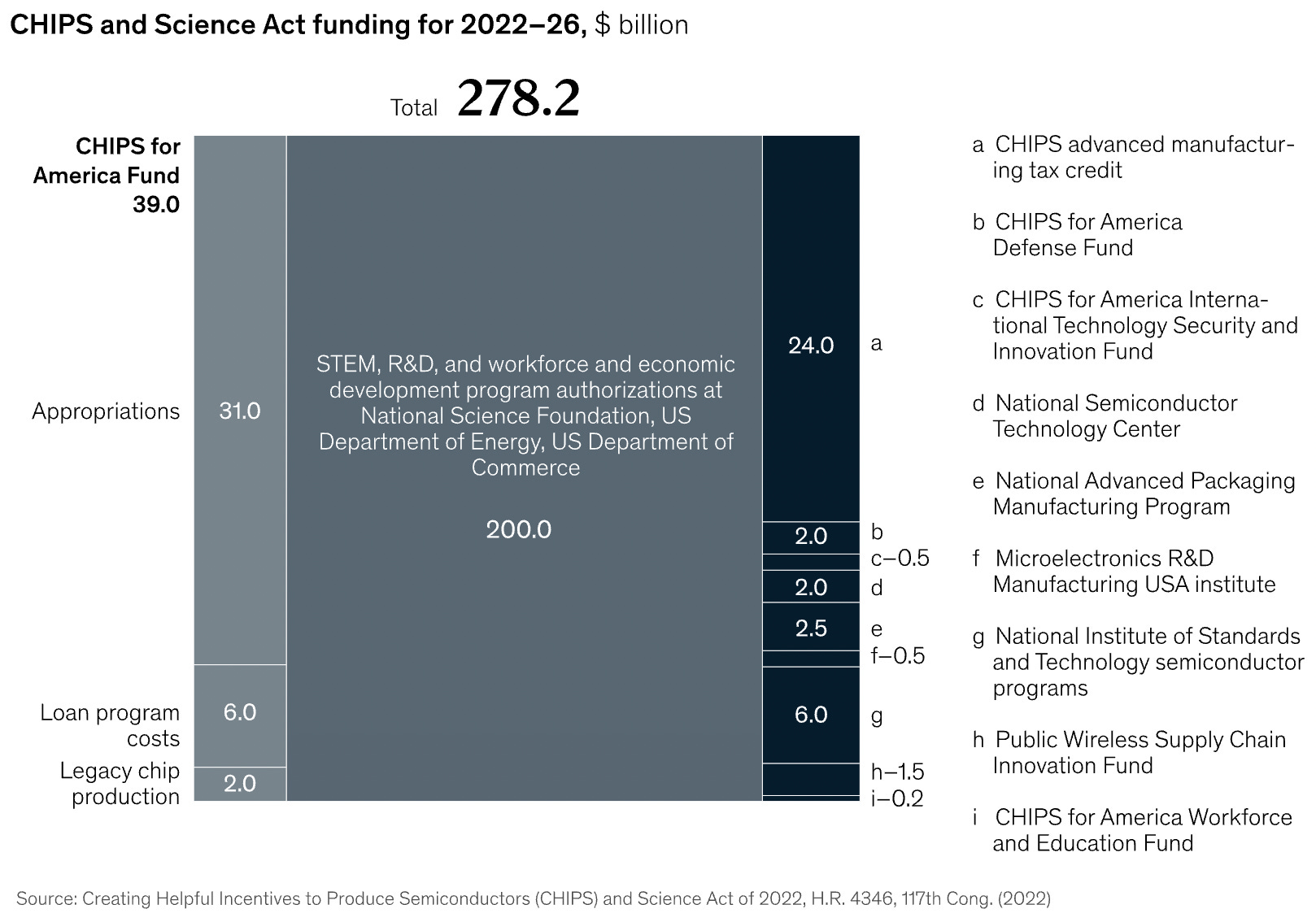
The editorial observes that a major impetus for the bill, stated explicitly by the White House, is to “counter China”, which has also engaged heavily in subsidizing favored industries. But just as the CHIPS and Science Act worked through Congress with bipartisan support, China has been seriously faltering economically and is scaling back their industrial policy.
This older editorial by Matthew Mitchell and Adam Thierer goes into more depth and summarizes some of the major problems.
It is easier to remember the successes than the failures, creating a distorted retrospective view of the performance of industrial policy.
The opportunity cost (what the private sector could have invested in if not for the public spending on subsidies) is not usually seen.
The planning problem: economies are very complex, and planners, even when they attempt to act in the broader societal interest—which they seldom do—are not able to make good decisions about how resources should be calculated. Many decades of experience with the failures of communism should make this clear.
Rather than deliberate industrial policy, the United States in the 1990s took a “permissionless innovation” approach to the high technology sector: especially avoidance of discriminatory taxes and light regulation. The European Union attempted a more hands-on approach of targeted subsidies. As a result, of the top 10 companies worldwide by market capitalization, eight are American, four of which are in the tech sector. None of European.
We should probably back up and consider what industrial policy actually is, because the term can be slippery. I define it as a deliberate effort on the part of a government to develop an industry seen to be of strategic value, a fairly broad definition that encompasses a wide range of strategies. In American history, industrial policy goes back to Alexander Hamilton in his Report on the Subject of Manufactures, where he argued for a system of high tariffs and industrial subsidies, for which the tariffs would pay. This approach was later picked up by the Whig Party’s American System (Henry Clay’s 1832 speeches). Elements of industrial policy can include subsidies for particular industries, government-run enterprises in particular areas, research and development spending, targeted tax benefits, and import substitution, often driven by high tariffs.
I’ve come back a few times to the paper by Bloom et al., Are Ideas Getting Harder to Find? The paper documents that over the last few decades, the number of researchers has increased dramatically, while researcher productivity (ideas per researcher) has fallen dramatically. These trends are probably closely related, and both symptoms of a bureaucratized research process, often but not always public, that has grown far beyond the level of social usefulness.
FairTax
FairTax is a proposal in the United States to eliminate the Internal Revenue Service and replace all income taxes, including corporate income taxes, with a national sales tax. The latest incarnation is a bill re-introduced by Buddy Carter, Congressman from Georgia.
The FairTax idea has some appeal to it. It would shift taxation away from production and toward consumption, so it should help growth. It would be more regressive than income taxes, but this issue could be addressed through rebates. It is conceptually simpler, or at least sounds that way if you don’t think about it too hard. The European Union relies heavily on a value added tax. The VAT is not exactly the same as a sales tax, as it is assessed at different points of manufacture as opposed to the point of sale, but in practice it is similar, and it probably closely resembles how a national sales tax would function. A VAT would also be administratively complicated, as discussed in this article.
Most Americans would agree that the current tax system is flawed and in need of reform, but the agreement ends when we discuss what that reform would look like. There are ideas like FairTax, or the flat tax, or land value tax, which have some conceptual appeal but are very far away from workable approaches. Slogans like “Abolish the IRS” sound like “Audit the Fed” or “Defund the police”; it might play well among segments of the electorate, but advocates clearly haven’t thought them through.
A more successful reform would be along the lines of the Tax Reform Act of 1986, a collaborative effort between President Reagan and House Speaker Tip O’Neill. The bill lowered the top tax bracket, raised the lowest bracket, increased the earned income tax credit, standard deduction, and personal exemption, increased the alternative minimum tax, and eliminated many deductions. The bill had some problems, but was an improvement to the tax system. What comparable effort is going on now?